
By Judith Hitchman, URGENCI’s Special Envoy on Social Solidarity Economy.
In many programmes these days, women and youth are catchwords, all too often tagged on to the end of some discourse.
The reality of what they can truly means is deeply illustrated by the Ossiniri family in the Aspe Valley in the Béarnaise Pyrenees.
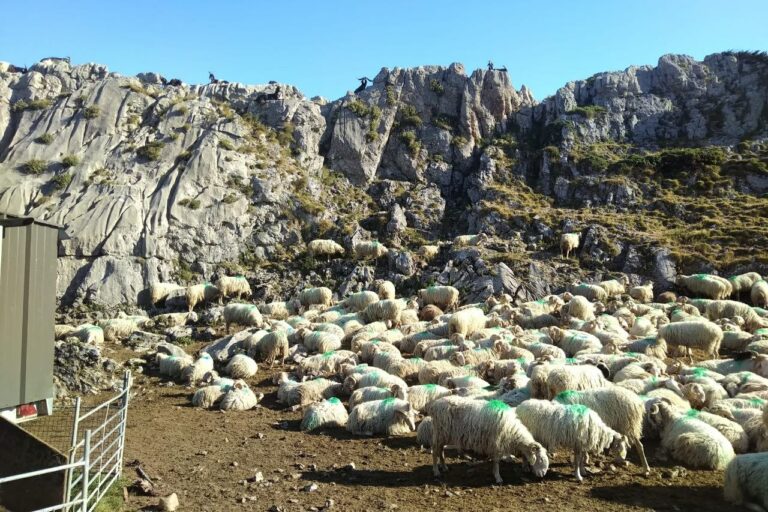
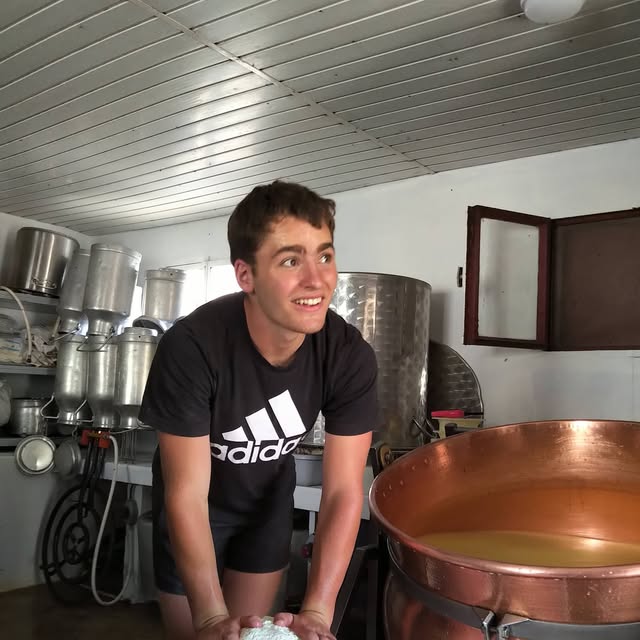
Rémi is 18, and has just finished his school leaving exams, majoring in Mathematics. When I asked him when he has started working in the high mountain pastures with his parents and elder brother, he gave me a cheeky smile and said ‘when I was 3 months old’. Obviously at that age he wasn’t working, but he, like his brother and sister move up to the high altitude pastures with their sheep and their cows as well as their sheep dogs (border collies) every year for the summer.
They use all the ancestral techniques of the region, and follow strict norms. When I asked him what his plans are, he said he has been accepted into a prestigious agricultural technical management college, so he can help with the financial management as well as the cheese making. His brother Batiste also works up in the summer pastures with their parents, milking the cows, and has been studying agricultural and cheese production.
This is a prime example of youth following their ancestral practices. Their elder sister has left their farm and moved to working as a butcher.
Marion and Emmanuel are the parents. Emmanuel spends several hours a day milking the ewes, and Marion makes the cheese – the famous AOP label Ossau Iraty. She is also a leader and very vocal member of the organizing committee of local cheese festival we attended.
When I asked Marion how she found raising her children in the summer pastures at the same time as doing such hard physical work, she said it hadn’t always been easy: she had worked with her babies strapped on her back in the beginning! But it was really worth it to see how much they loved the lives they now lead.
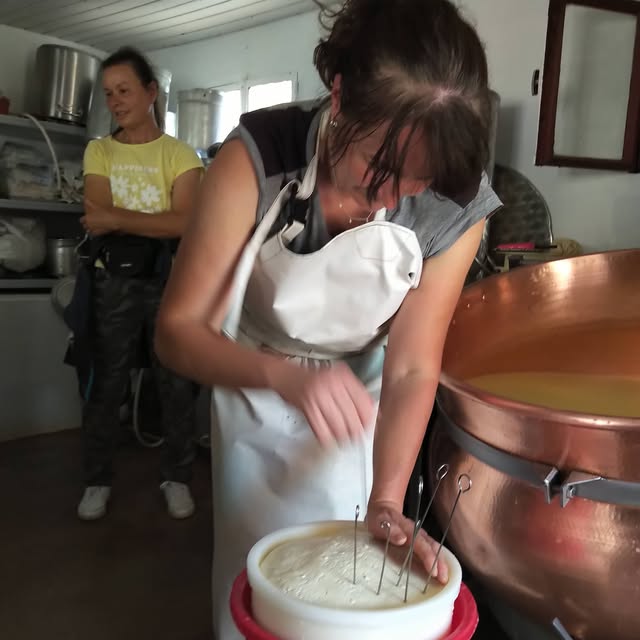
There are many outstanding features in their work. Firstly, over and above their own work, they share the cheese-making dairy and the hut they use for maturing the cheese (it takes 4-5 months to mature) with another shepherdess, thereby collectivizing all the means of production. The mountain pastures are considered as Commons, and rented to them by the local authorities. They also share the pastures with the other shepherdess. Both these elements are clearly based on social and solidarity economy. This collective attitude extends to all aspects of their lives.
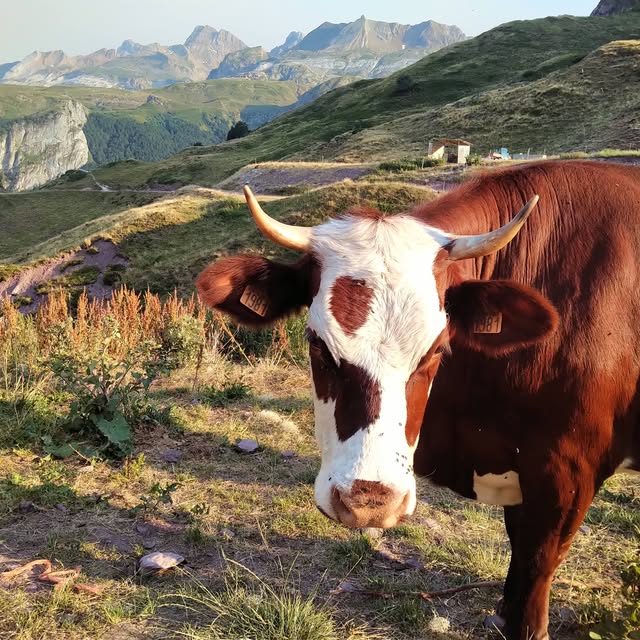
But above all else, the obvious love for all their animals and for each other shines in their eyes. Be it the gentle caress that Batiste gives a passing cow (they all have names), or the amazing bond that Rémi has formed with his 4-month-old collie, Maya, or the way in which they all work together in harmony in such close quarters. Later, at the cheese fair, his cheese was deservedly one of the proud prize-winning shepherds
The question of generational renewal is a hot topic in the whole region, and indeed around Europe. Many traditional shepherds are aging and male. The Spanish shepherd’s schools are key leaders in most ways, with a near gender balance and a young new neo-rural population that is often highly educated but looking for a different life-style. The Transhumances New Milky Ways project hopes to highlight this and much more, and work towards solutions.
This is a picture of a woman and youth we don’t often have the privilege to see when reading policy texts, but it is a reality, and a very happy and encouraging one at that.
Transhumances: InterRegional Education in AgroSilvoPastoralism
PROGRAMME ERASMUS+ 2025-1-FR01-KA220-ADU-000363766
Funded by the European Union. Views and opinions expressed are however those of the author(s) only and do not necessarily reflect those of the European Union or the European Education and Culture Executive Agency (EACEA). Neither the European Union nor EACEA can be held responsible for them.