By Isabel Alvarez Vispo, URGENCI’s President.
When a project is coming to an end, and you feel it has truly been useful, there’s a beautiful sense of the journey taken, but also a pressure to ensure that what has been learned and created doesn’t end up stored away in a drawer, and instead becomes useful for the networks that took part in it.
The VIVID project began three years ago with the goal of collectively exploring what it means, for initiatives working around community-supported food, to be viable, visible, and livable. How can this be translated into practical tools?
The need had already been identified; the challenge was to respond to it through practice, not just through reflections or bilateral exchanges, which are valuable when shared but whose impact is limited beyond personal mutual support. While that support is important, we felt it wasn’t enough to meet our needs.
This is how the project was born. Over the months, people from initiatives within the URGENCI network—across France, Germany, Belgium, Italy, the Czech Republic, Poland, and the Basque Country (Euskal Herria)—have worked together. Tools have been developed for self-assessment of our initiatives, helping translate the question “How are we doing?” into data. At the same time, tools have been shared to help us become more visible and improve our communication, always within the broader debate around new technologies, AI, and system-driven tools… how can we be visible in a world whose aim is for us not to exist? With an awareness of the context we operate in, we have tried to share tools that help us move forward, and above all, to create spaces where we can collectively address our doubts.
Finally, we have asked ourselves what it means for our initiatives to be livable. In this context, we have shared tools to build common languages, to define what it means to care, to be cared for, and to feel safe both within and beyond our networks.
Throughout these months, we have developed tools and theoretical materials, but life has also required us to put our own principles into practice. Projects do not happen in neutral spaces; life does not pause while we develop tools and write reports. As the project progresses, we are shaped by families, discomforts, illnesses, celebrations, joys, sorrows, farewells, caregiving, dependencies, in short, by living itself. During these months together, we have tried to understand and apply the principles we were working on: acknowledging absences and availability, offering and asking for help when needed, trying to understand different circumstances and realities, even when they are far from our own. Ultimately, we have tried to build community and sustain ourselves through it.
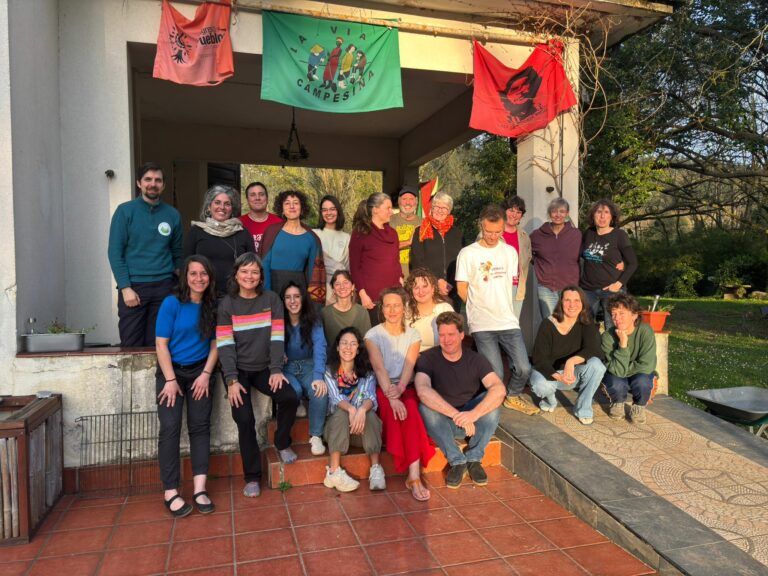
On March 16, we gathered in Basoa (Artea) to share five days of learning together. As throughout the project, life made itself visible, and we put into practice what it means to work collectively. At times, we had to ask for help and improvise; at others, we had to respond and support, and we did so as best we could, incorporating what we had learned and built together over these months. There was also time to learn what care means for other networks working with migrants and people in vulnerable situations, people who, in the eyes of part of society, are not even considered worthy of care. We also had the chance to celebrate ourselves and make visible the work done during this time.
In short, we had time to live together, with all that entails, and above all, to breathe deeply in that forest refuge that is Basoa, which gave us the energy to keep moving forward.